Why Webb’s Depth of Knowledge Belongs in Your Exam. And Bloom’s Taxonomy Doesn’t
Bloom’s Taxonomy tells you what you planned to teach. Webb’s Depth of Knowledge tells you what your exam actually measures. For assessment, only one of them matters.
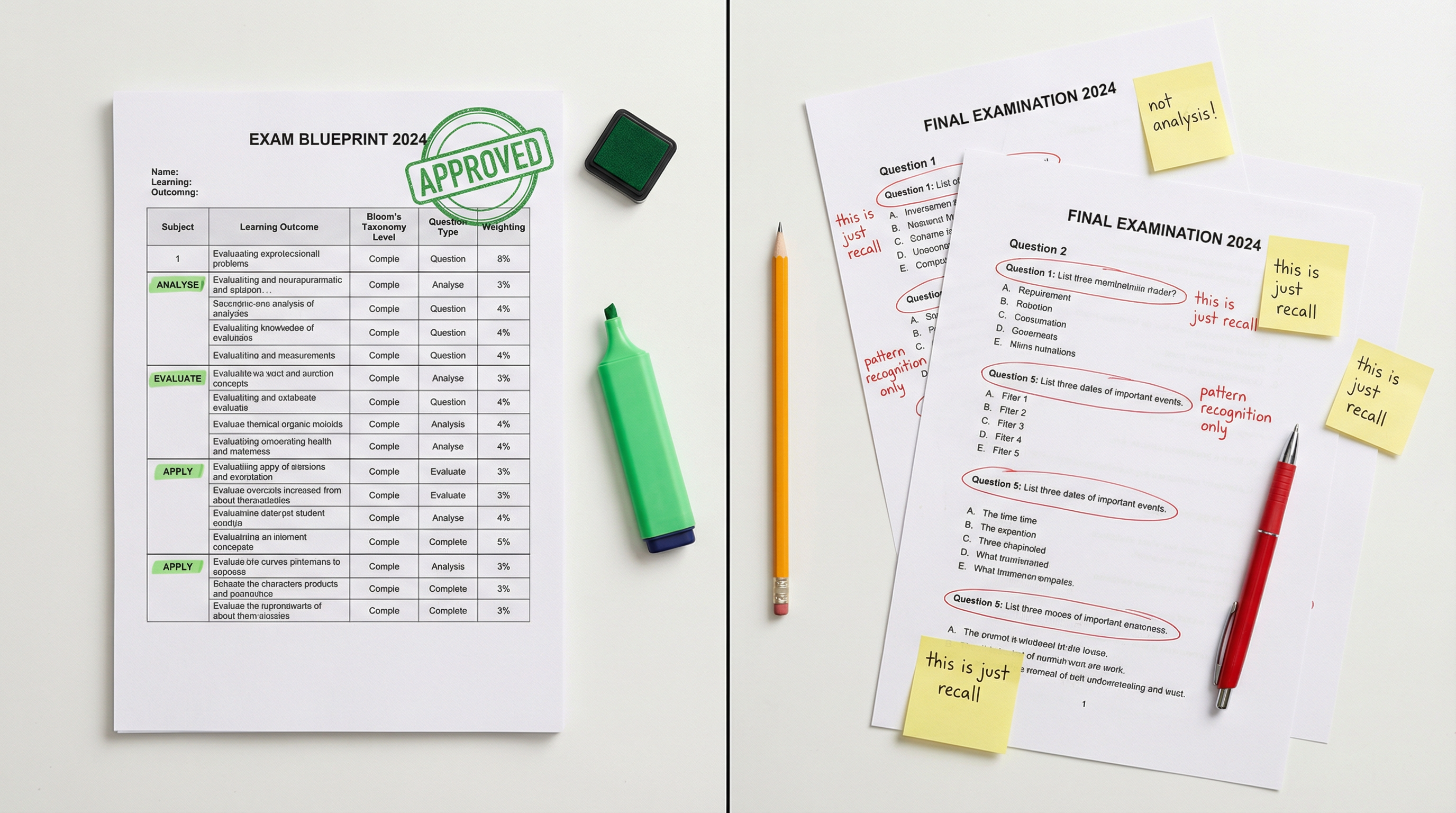
Bloom’s Taxonomy is everywhere in education. It is on curriculum documents, lesson plans, assessment blueprints, and workshop slides. It has been the default framework for describing cognitive demand for over sixty years.
It is also the wrong tool for writing exam questions.
What Bloom’s Actually Measures
Bloom’s Taxonomy classifies educational objectives into six levels: remember, understand, apply, analyse, evaluate, create. It was designed to help educators plan teaching. To structure a curriculum so that students progress from foundational knowledge to higher-order thinking over the course of a programme.
For curriculum design, it works well. It gives educators a shared vocabulary for talking about what they want students to learn. It helps sequence learning activities from simple to complex.
But Bloom’s describes what the teacher intends to teach. It does not describe what the exam question actually demands of the candidate.
The Gap Between Intention and Demand
Here is the problem. A question writer tags their question as “analyse” on the Bloom’s scale. The stem presents a complex scenario. The language is technical. The options require comparison.
But the answer can be reached by recognising a single pattern. The candidate does not need to analyse anything. They need to recall what that pattern looks like. The question has been tagged at a higher cognitive level than it actually operates at.
This happens constantly because Bloom’s levels are defined by the verb in the learning objective, not by the cognitive work the question requires. “Analyse the relationship between X and Y” sounds like analysis. But if the relationship is a well-known fact, the question is recall wearing a more impressive label.
Bloom’s tells you what the question writer intended. It does not tell you what the candidate has to do.
What Webb’s Depth of Knowledge Measures
Webb’s Depth of Knowledge (DOK) was designed specifically for assessment. Not for curriculum. Not for teaching. For measuring what a test item actually demands of the person answering it.
DOK has four levels:
DOK 1: Recall and Reproduction. The candidate retrieves a fact, definition, or procedure from memory. One step. One piece of knowledge. No interpretation required.
DOK 2: Skill and Concept. The candidate applies a concept or completes a multi-step procedure. They must make a decision about how to approach the problem. More than recall, but the path is relatively straightforward.
DOK 3: Strategic Thinking. The candidate must reason, plan, or justify. Multiple valid approaches may exist. The task requires integration of knowledge from different areas. There is no single obvious path to the answer.
DOK 4: Extended Thinking. The candidate must investigate, synthesise across sources, or apply knowledge to novel situations over an extended period. This level is rare in timed examinations but relevant for coursework, projects, and portfolio assessment.
The critical difference: DOK is assessed by examining what the question actually requires, not what the question writer intended. A question tagged as DOK 1 might have a complex scenario, technical vocabulary, and expert-level content. It is still DOK 1 if the answer requires only recall.
Why This Matters for Professional Examinations
At undergraduate level, DOK 1 and DOK 2 questions are appropriate. Students are building knowledge and learning to apply procedures. A question that asks them to recall a mechanism or apply a formula to a standard problem is testing what the curriculum expects.
At professional level, DOK 1 questions are a problem. A graduating practitioner should not be passing their qualifying exam by memorising facts. They should be demonstrating that they can reason under uncertainty, integrate information from multiple sources, and make defensible decisions when the textbook answer does not apply cleanly to the situation in front of them.
If your professional exam is dominated by DOK 1 questions, it is not measuring professional competence. It is measuring memory. And memory is a poor predictor of safe, independent practice.
Bloom’s makes this hard to detect because a DOK 1 question can be tagged as “analyse” or “evaluate” based on the verb in the learning objective. The blueprint looks balanced. The exam is not.
Webb’s makes it visible. DOK is determined by what the candidate must do, not by what the question writer wrote in the metadata. A DOK audit of your exam tells you what your assessment is actually measuring, not what you hoped it was measuring.
The Practical Difference
Consider two questions on the same topic.
Question A: “What is the primary mechanism by which this class of drug reduces blood pressure?”
That is DOK 1. Recall. One fact. One step.
Question B: “A patient is taking three medications that each affect blood pressure through different mechanisms. Their blood pressure remains elevated. Based on the pharmacological interactions between these agents, which medication adjustment is most likely to achieve target blood pressure without introducing a contraindicated combination?”
That is DOK 3. The candidate must understand three mechanisms, consider their interactions, identify the adjustment that addresses the clinical goal, and check it against contraindication criteria. Multiple pieces of knowledge must be integrated. The answer requires reasoning, not retrieval.
Both questions test pharmacology. Both could be tagged as “apply” or “analyse” under Bloom’s. Only DOK distinguishes between them in a way that matters for assessment quality.
What CrtQ Does With This
CrtQ uses Webb’s DOK, not Bloom’s Taxonomy, to classify the cognitive demand of every question.
In the Lite tier, the DOK level is displayed as a static indicator based on the structure of the question. The author sees whether their question is operating at DOK 1, 2, or 3 and can decide whether that matches the purpose of the assessment.
In the Pro tier, the DOK classification is live. The AI evaluates the actual cognitive work the question demands and updates the classification as the author edits. If the testing point says “strategic thinking” but the question collapses to recall, the platform shows the mismatch.
This is not about labelling questions for compliance. It is about making visible the gap between what you intended to test and what your question actually tests. That gap is where professional exams lose their validity. And it is invisible under Bloom’s.
The Shift
Bloom’s tells you what you planned to teach. Webb’s tells you what your exam actually measures.
For curriculum design, use Bloom’s. For assessment quality, use Webb’s. They are not interchangeable. They measure different things. And confusing them costs your exam its ability to discriminate between competent and incompetent candidates.
If your exam blueprint is built on Bloom’s, ask yourself: when was the last time someone checked whether the questions actually operate at the cognitive level they were tagged with?
If the answer is “never,” you have a blueprint that describes your intentions, not your exam.
Webb’s closes that gap. So does CrtQ.
CrtQ. Sharper questions. Smarter exams. crtq.ai